

Two weeks of war in Iran unleashed more carbon pollution than Iceland does in a year
US and Israeli bombardment is inflicting climate costs for decades to come
By Patrick Bigger, Benjamin Neimark, and Fred Otu-Larbi
The Trump administration’s pursuit of “energy dominance” has put the US on a trail of military intervention in oil-producing countries across the globe, from Ecuador and Venezuela to Nigeria—and now to Iran. Since February 28 of this year, Iran and Southern Lebanon have been pummeled by the US and Israel with thousands of aerial bombardments, and US and foreign tankers along with oil-producing refineries have been damaged and destroyed in the fighting. Iran has completely shut down traffic through the Strait of Hormuz, and with it, 20% of the world’s oil supply and 19% of global supply of liquefied natural gas. No matter which of the many reasons Trump has since provided for attacking Iran, the US intervention in Iran is now clearly about oil, plunging the Middle East into another crisis and deepening the social, economic, and environmental costs of war.
As the US and Israeli illegal and ill-conceived military attacks continue to kill thousands and displace millions across the region, these costs continue to mount. While early calculations show that US financial costs are now estimated at $16.5 billion, acute environmental harms caused by US and Israeli bombardment of oil refineries, desalination plants, and military facilities could double if not triple in the next ten days. Our analysis finds that the total greenhouse gas emissions from the first 14 days of assault is more than 5 million tonnes of carbon dioxide, which is higher than the total climate pollution of Iceland in 2024. This figure is also equivalent to the emissions from 1.1 million gas-powered cars over a year and represents over $1.3 billion in climate damage.
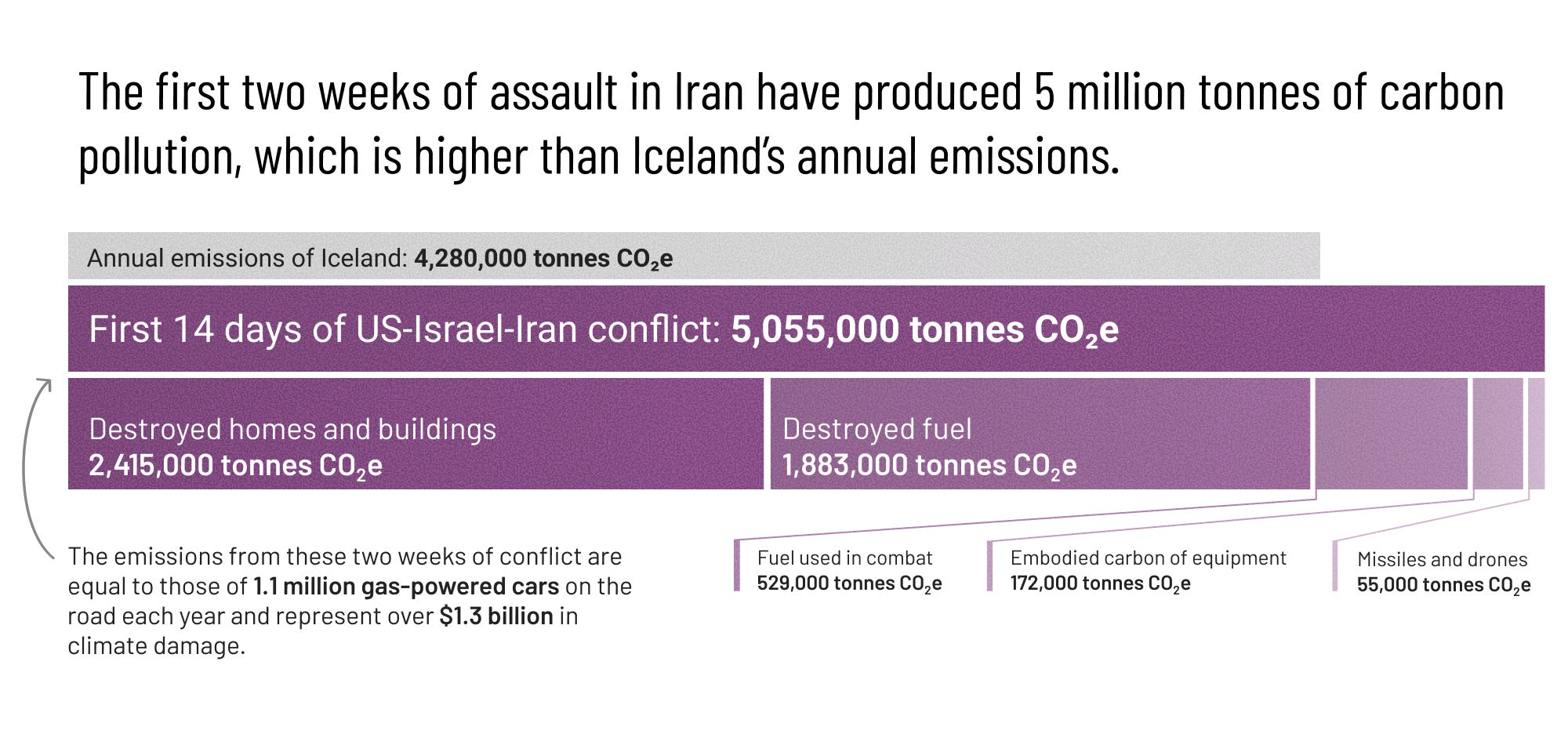
Assessing the environmental impacts from armed conflict, especially greenhouse gas emissions, is an often overlooked and underresearched dimension of the humanitarian and economic damage of war. Following a similar method used by researchers to calculate climate damage in Gaza and Ukraine, we conducted a combined assessment model of direct “tailpipe” emissions, indirect supply chain emissions, and conflict emissions—including destroyed equipment, missiles and drones used, destroyed fuel in storage and oil tankers, fuel used in combat operations, and destroyed civilian infrastructure.
The carbon costs of the war will continue to rise dramatically as it drags on for several reasons. First, as the arsenals of the US and Israel become depleted, the embodied emissions of building new weapons, along with fuel used to deliver them to the region, will rise. Second, targeting the region’s oil infrastructure is causing significant emissions as fossil fuels burn uncontrollably, just as they did during the Gulf War. Lastly, as French and UK ships now sail to the Middle East, expectations are that more countries may join the fight, at least to protect their own military and economic assets in the region, thereby increasing emissions via “defensive” posture.
However, the most significant climate impact of the attack on Iran will not be the emissions of the conflict itself, but from its aftermath. As the US continues to press on in its ill-conceived quest for “energy dominance,” fossil fuel production will be expanded in the name of energy security, locking in emissions from extraction infrastructure for decades. In addition, the emissions that will be generated in clearing rubble and then rebuilding are the biggest cause of emissions in any war. Reconstructing infrastructure in the impacted region of 14 countries from Cyprus to Azerbaijan—including homes, roads, hospitals, schools, and oil and transport infrastructure—is not only costly but carbon-intensive. We found that rebuilding Gaza and Lebanon after the war will produce at least 24 times more than the emissions from the war alone. In the Ukraine conflict, this number was roughly equal to that of conflict emissions at a massive 56 million tons of carbon dioxide—and cost over 43 billion dollars in damages.
In the meantime, the economic costs of this brutal war will be borne on the backs of working people. Energy price spikes have already begun to regressively affect the US economy and not only directly raise the cost of things like gasoline and heating, but will also indirectly raise the price of everything that currently depends on oil and natural gas—including food. As prices for everything rise, inflation will justify austerity, including further climate disinvestment.
The Trump Administration’s costly and incoherent military ploy to achieve “energy dominance” through violence manufactures economic crisis in the short-term, and will have devastating long-term social and environmental effects. The data shows that for decades to come, the people in Iran and across the planet will continue to suffer the consequences.